10 November 2026
Tax Lawyers in Serbia
Get an overview of the taxation system in Serbia for companies and investors, and ask our tax lawyers in Serbia for advice on your specific situation.
Businesspersons from abroad can solicit details and information about the taxation system in Serbia, before opening a company, from our Serbian tax lawyers.
How are companies taxed in Serbia?
Limited liability companies, joint stock companies, limited and general partnerships in Serbia are obliged to pay the corporate tax and are seen as taxpayers in this country. Corporate taxpayers are either residents, such as companies incorporated in Serbia or managed and controlled from Serbia, which are taxed on their worldwide profit, or non-residents. These are taxed only on profit earned through a permanent establishment in Serbia and, through withholding tax, on certain Serbian-source income. You can solicit legal support for the above-mentioned types of entities and for the tax legislation imposed from our team of tax attorneys in Serbia.
What is the corporate tax rate in Serbia?
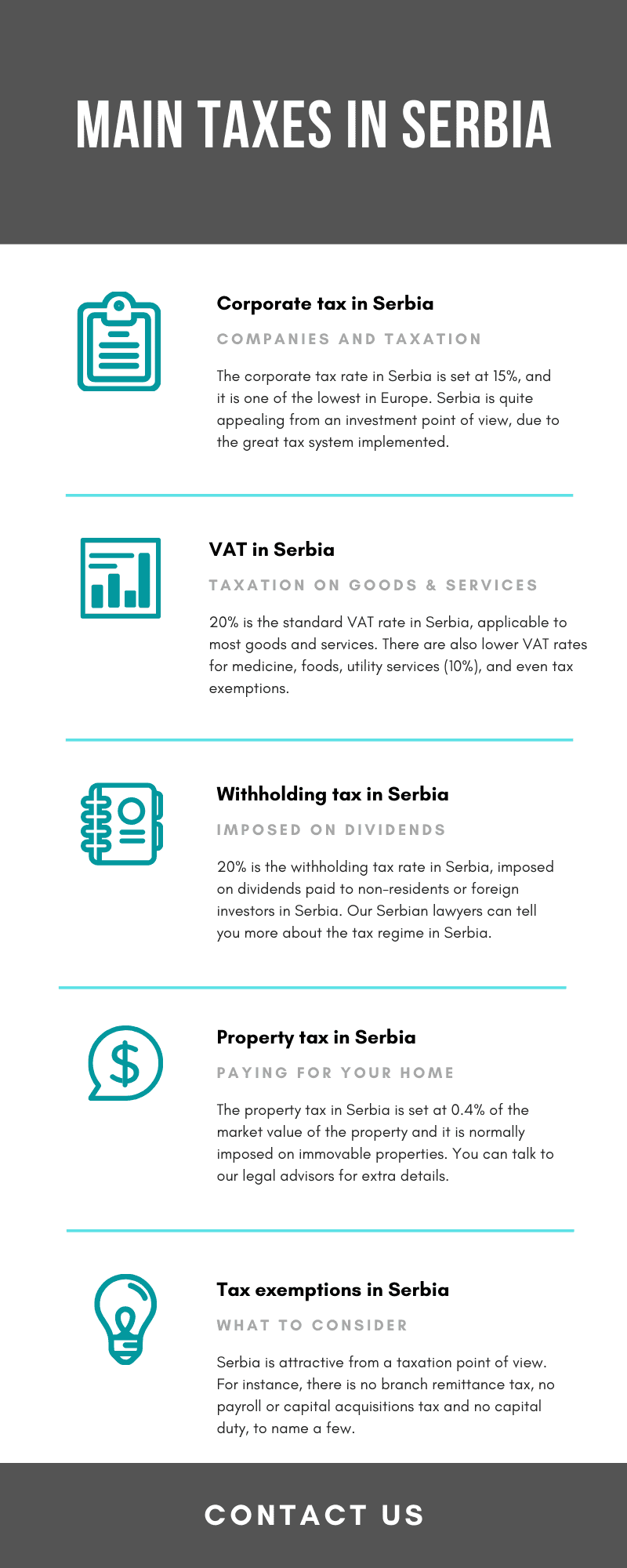
The corporate tax rate in Serbia is set at 15%, one of the lowest in Europe, and it is collected from companies with establishments in the country. It is good to know that the dividends paid by a company in Serbia to another Serbian business are not subject to the corporate income tax. The corporate income tax return and final payment are due within 180 days of the end of the tax year, with monthly advance payments during the year.
How can your lawyers help me with taxation issues in Serbia?
Our Serbian tax lawyers support foreign investors at every stage of their business:
- choosing the right structure (subsidiary, branch or representative office) and checking whether the activities could create a permanent establishment in order to know the taxes applied;
- assistance with applying double taxation treaties and preparing the tax residence certificates needed for reduced withholding tax on dividends, interest and royalties;
- VAT registration, appointment of a tax representative for non-resident companies and set-up on the electronic invoicing system (SEF);
- reviewing eligibility for tax incentives (IP box, R&D deductions, state aid) and the transitional rules introduced in 2026;
- representing the company before the Tax Administration in tax audits, requests for tax opinions from the Ministry of Finance and tax disputes. We can represent you in fron of the local authorities based on a power of attorney.
What are the taxable incomes in Serbia?
Residents in Serbia are subject to taxation on their worldwide income, as settled in the country. The non-resident persons in Serbia must pay the taxes on incomes generated in this country. The capital gains, the employment income, the business income, the profit generated in agriculture or the ones derived from the immovable property are subject to taxation in Serbia.
For individuals, these types of income are taxed under the Law on Personal Income Tax: salaries at a flat 10% (after a monthly non-taxable amount of RSD 34,221 in 2026), and dividends, interest and capital gains generally at 15%. Companies pay 15% corporate income tax on their profit, including capital gains.
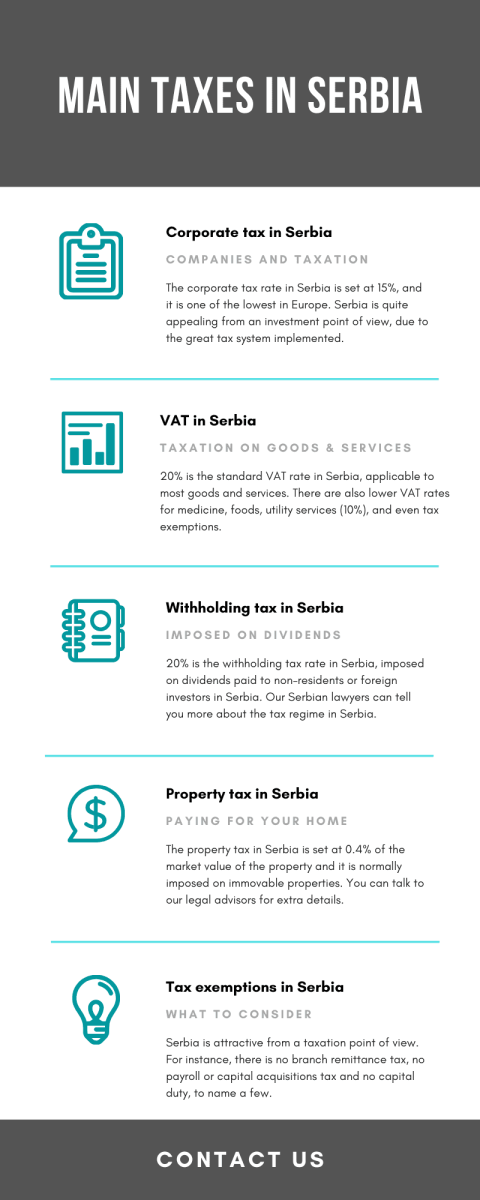
Here is an infographic that explains more:
What are the VAT rules in Serbia?
Just like many countries worldwide, Serbia aligns with the requirements related to the VAT imposed on products and services, while exports from Serbia are exempt with the right to deduct input VAT (zero-rated). At the moment, the standard VAT rate in Serbia is set at 20%, but a reduced rate of 10% is imposed on particular items like: foods, certain medicines and medical devices, utility services, accommodation services, and newspapers.
If you want to understand better the tax regime and VAT registration procedures when setting up a business, you can ask our tax attorneys in Serbia for support.
What is the withholding tax in Serbia?
In Serbia, the withholding tax of 20% is imposed on dividends which are paid to a non-resident or foreign shareholder in the country. If a double tax treaty is signed by Serbia, then the withholding tax will be reduced. As for the interests and royalties paid to a foreigner in Serbia, these are levied with the same tax percentage. A 25% rate applies to: interest, royalties, rental income and service fees paid to entities resident in jurisdictions with a preferential tax system (tax havens). To apply a reduced treaty rate, the foreign recipient must provide a certificate of tax residence.
Can you help me with tax minimization in Serbia?
Yes, of course, we use only legal tax minimization methods. Numerous financial tools can be used in companies established in Serbia, to cut the amount of taxes. Tax minimization methods are great options for company owners in Serbia, so if you would like to adopt a specific method, you can solicit the guidance and support of our Serbian tax lawyers. They will, first of all, develop a tax plan in agreement with the company’s financial operations. This way, you can avoid paying more taxes.
What tax minimization methods do you recommend?
Here are a few examples of tax minimization methods that can be adopted in your firm:
- Business-related expenses, such as: employee bonuses, office supplies and professional subscriptions, are deductible when properly documented, while entertainment (representation) expenses are deductible only up to 0.5% of total revenue.
- Donations for health, education, science, humanitarian, sports, environmental and similar public-interest purposes are deductible up to 5% of total revenue.
- Tax losses can be carried forward and offset against profits of the following five years.
- Innovative companies can use the IP box regime (80% of qualifying income from registered IP excluded from the tax base) and the double deduction of R&D costs. Large investments of over RSD 1 billion in fixed assets with at least 100 new jobs qualify for a 10-year corporate tax exemption. However, the 2026 amendments abolish this incentive (it remains available only to investors who meet the conditions by 31 December 2027), as well as the 30% tax credit for investments in startups (available only where the conditions are met by 31 December 2026).
For complete information and details about the tax minimization methods that can be used in your company, please feel free to talk to one of our tax lawyers in Serbia.
Which laws regulate taxation in Serbia?
Taxation in Serbia is regulated by a set of separate laws, each covering one type of tax. Companies pay profit tax under the Law on Corporate Income Tax (Official Gazette of RS No. 25/2001, as amended), while salaries, dividends, interest and other income of individuals are taxed under the Law on Personal Income Tax (No. 24/2001).
VAT is governed by the Law on Value Added Tax (No. 84/2004), and payroll contributions by the Law on Mandatory Social Insurance Contributions (No. 84/2004).
Property tax and the tax on the transfer of absolute rights are set by the Law on Property Taxes (No. 26/2001), and excise duties by the Law on Excise Duties.
Registration, filing, payment, tax audits and penalties follow the Law on Tax Procedure and Tax Administration (No. 80/2002), which is applied by the Tax Administration (Poreska uprava) under the Ministry of Finance.
Companies must also comply with the Law on Electronic Invoicing and the Law on Fiscalization, and cross-border income is further governed by the double taxation treaties concluded by Serbia, which take precedence over domestic law. These laws are amended frequently (most recently by a package published in Official Gazette No. 80/2026), so the version in force should always be checked before a transaction.
If you want more details about the tax regime in Serbia or about how you can register a company in this country, please feel free to contact our Serbian tax lawyers.